The biggest technology trends of 2026 share one theme: AI has stopped being a pilot project and turned into everyday business infrastructure. AI agents now take actions instead of just answering questions. Regulators are enforcing rules, and attackers are using the same tools defenders are. For business leaders, the question has changed from “should we adopt this?” to “how do we run it safely, profitably and at scale?”
Gartner called 2026 a pivotal year in which disruption, innovation and risk are all expanding faster than ever. Its analysts said they saw more innovations emerge in one year than in any year before. That pace makes prioritising hard. Not every trend deserves budget, and some will matter far more in your industry than in others.
This guide to the top tech trends 2026 has to offer cuts through the noise. Below are the 10 business technology trends that matter most to companies of every size. For each one you will find what it is, why it matters now, and one practical first step. Whether you run a 20-person firm or an enterprise IT team, use the list to pressure-test your digital transformation 2026 roadmap for the rest of the year and into 2027.
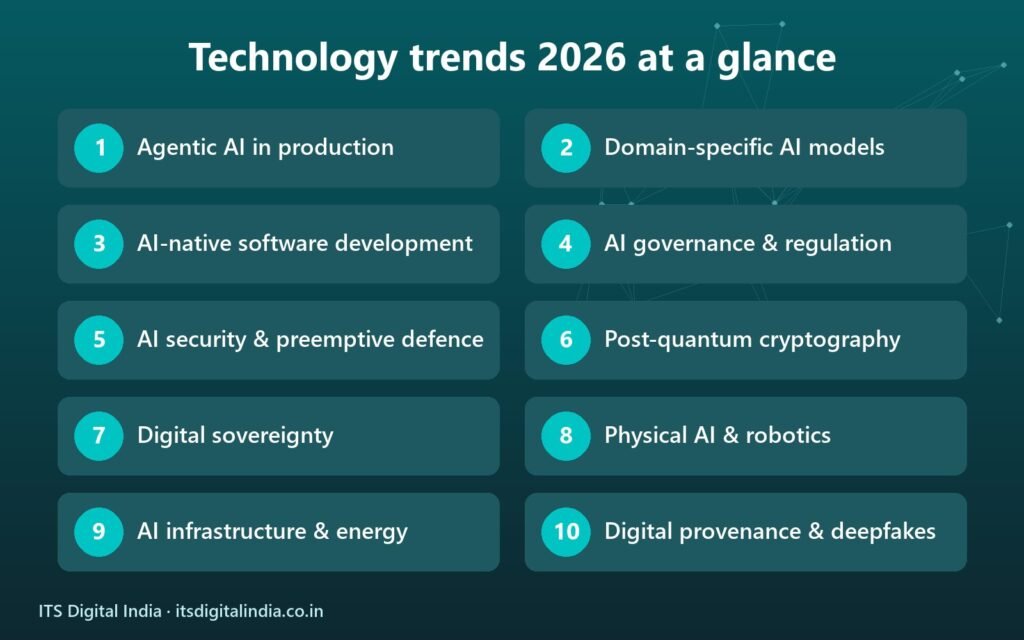
The top 10 technology trends of 2026
1. Agentic AI moves from pilot to production
Agentic AI is the defining technology trend of 2026. Unlike a chatbot that answers questions, an AI agent plans and carries out multi-step tasks: it books, reconciles, files, follows up and escalates. Increasingly, several specialised agents work together as a “multiagent system”, one of the trends on Gartner’s 2026 list.
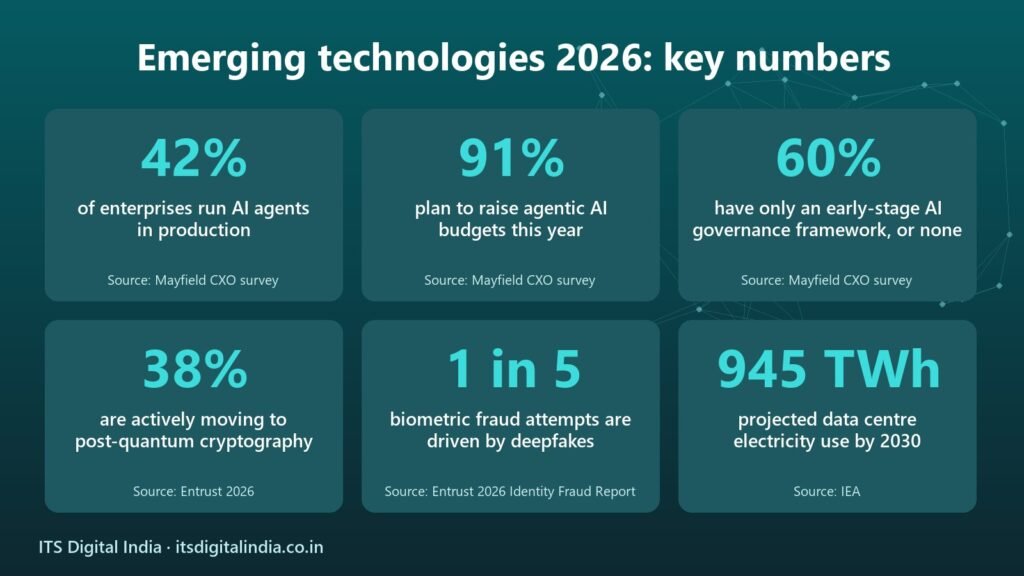
Adoption is real. In Mayfield’s 2026 CXO survey of 266 Fortune 2000 IT leaders, 42% of enterprises had AI agents in production and 91% planned to raise agentic AI budgets this year. Gartner also forecasts that by 2028, AI agents will intermediate about 90% of B2B buying, more than $15 trillion in spend. If your customers’ purchasing agents cannot read your catalogue, pricing and terms, you may not even be considered.
Why it matters: Agents shift AI from saving minutes to running whole processes, such as invoice matching, IT tickets, lead qualification and customer service.
First step: Pick one high-volume, rules-heavy workflow. Map where a human must approve, and launch an agent with clear limits and audit logs.
2. Domain-specific AI models beat one-size-fits-all
General-purpose large language models are impressive, but they often fall short on specialised work such as insurance claims, legal review or clinical notes. Domain-specific language models (DSLMs) are trained or fine-tuned on industry data. They tend to deliver better accuracy, lower cost and easier compliance.
Gartner predicts that by 2028, more than half of the generative AI models enterprises use will be domain-specific. Smaller, focused models are also cheaper to run, which matters as AI usage scales.
Why it matters: Your proprietary data, such as past contracts, support tickets and product specs, becomes a competitive asset when it powers a model tuned to your business.
First step: Audit which AI use cases suffer from generic answers. Then ask your vendors about industry-tuned models before building your own.
3. AI-native software development
Software teams are being reshaped by AI that writes, tests and documents code. AI-native development platforms let small teams, and even domain experts with little coding background, build business applications far faster than before.
Gartner expects that by 2030, these platforms will lead 80% of organisations to turn large engineering teams into smaller, AI-augmented ones. Developer productivity is already the top agentic AI priority: in the Mayfield survey, 70% of CXOs ranked it in their top three.
Why it matters: Custom software that once took a year and a large budget can now be built in weeks. This makes bespoke tools viable for mid-sized firms, not just enterprises.
First step: Give developers approved AI coding tools with security guardrails. Measure cycle time and defect rates before and after adoption. (This is how we build at ITS Digital India: see AI-assisted software development with Vibe Coding.)
4. AI governance and regulation get real
The era of voluntary AI principles is ending. On 2 August 2026, the EU AI Act’s Article 50 transparency rules became enforceable. Businesses using AI with EU users must now tell people when they are talking to a chatbot, label deepfakes and mark AI-generated content in a machine-readable way. Fines can reach €15 million or 3% of global annual turnover.
The EU’s Digital Omnibus, in force since 27 July 2026, pushed the heavier high-risk rules back. AI used in areas like hiring and credit scoring now must comply by 2 December 2027. AI built into regulated products follows on 2 August 2028. That is a delay, not a pause.
Most firms are not ready. Mayfield found that 60% of organisations have only an early-stage AI governance framework, or none at all.
Why it matters: AI governance is now a condition of selling, especially to enterprise and public-sector buyers who ask suppliers about AI risk.
First step: Build an inventory of every AI system you use or sell, assign an owner to each, and classify them by risk level.
5. AI security and preemptive cybersecurity
Attackers now use AI to write convincing phishing emails, find vulnerabilities and automate intrusions. Defenders are responding in two ways.
First, AI security platforms protect a company’s own AI from new threats such as prompt injection, data leakage and agents acting outside their remit. Gartner expects more than half of enterprises to use these platforms by 2028. Second, preemptive cybersecurity uses AI to predict and block attacks before they land, instead of reacting afterwards. Gartner forecasts that preemptive tools will take half of all security spending by 2030.
Why it matters: Every AI agent you deploy is a new identity with access to systems and data. Without controls, it is also a new way in for attackers.
First step: Treat AI agents like employees. Give each one a unique identity and the least access it needs, and monitor what it does.
6. Post-quantum cryptography moves up the agenda
Quantum computers powerful enough to break today’s encryption do not exist yet, but the deadline to prepare does. In NIST’s draft transition plan, widely used algorithms such as RSA-2048 are deprecated after 2030 and disallowed after 2035. NIST published its first three post-quantum standards in August 2024. In the US, new national security system purchases must support quantum-resistant algorithms from 1 January 2027.
The risk is already here because of “harvest now, decrypt later” attacks: criminals steal encrypted data today and wait until they can unlock it. Yet only 38% of organisations are actively moving to post-quantum cryptography, according to Entrust’s 2026 research.
Why it matters: Past cryptographic migrations have taken 10 to 20 years. Any data that must stay confidential beyond 2030, such as health records, contracts or intellectual property, is exposed now.
First step: Inventory where your business uses encryption, including certificates, VPNs, APIs and vendor products. Ask key suppliers for their post-quantum roadmap.
7. Digital sovereignty and confidential computing
Geopolitics is reshaping where data lives. “Geopatriation” means moving data and applications from global public clouds to sovereign clouds, regional providers or your own data centres. Gartner expects more than 75% of European and Middle Eastern enterprises to geopatriate workloads by 2030, up from under 5% in 2025.
A related trend is confidential computing, which keeps data encrypted even while it is being processed. Not even the cloud provider can see it. Gartner predicts that by 2029, more than 75% of operations running on untrusted infrastructure will be protected this way.
Why it matters: Customers, regulators and governments increasingly ask where data is stored and who can access it. A good answer can win deals, especially in finance, healthcare and the public sector.
First step: Map which data and workloads are subject to residency rules. Check whether your cloud providers offer sovereign regions or confidential computing options.
8. Physical AI and robotics leave the lab
AI is moving off the screen and into the physical world. Physical AI puts intelligence into machines that sense, decide and act, such as robots, drones and smart equipment. In 2026, humanoid robots began doing real shifts. Agility Robotics’ Digit, for example, moved more than 100,000 totes in a live warehouse deployment with GXO Logistics.
Keep expectations grounded, though. Gartner expects relatively few companies to run humanoid robots at production scale by 2028, citing cost, battery life and performance limits. The near-term wins come from simpler, task-focused robots such as autonomous mobile robots, robotic picking arms and inspection drones.
Why it matters: Labour shortages in manufacturing, logistics and healthcare make automation of “dull, dirty and dangerous” work a strategic priority.
First step: Identify repetitive physical tasks with high turnover or injury rates. Pilot robots-as-a-service before committing to capital purchases.
9. AI infrastructure and the energy crunch
Every AI query runs on chips, data centres and electricity, and demand is surging. The International Energy Agency projects that data centre electricity use will more than double to around 945 terawatt-hours by 2030, roughly Japan’s total consumption today. The IEA also estimates that 20% of planned data centres could face delays connecting to the grid.
Companies are responding with hybrid computing, which mixes CPUs, GPUs, specialised AI chips and on-premises hardware to balance cost and performance. Gartner expects more than 40% of leading enterprises to adopt hybrid computing architectures in critical workflows by 2028, up from 8% in 2025.
Why it matters: AI compute costs can spiral quickly, and energy use is now part of sustainability reporting and customer scrutiny.
First step: Track AI spending per use case. Match each workload to the cheapest model and infrastructure that does the job well.
10. Digital provenance and the fight against deepfakes
As AI-generated content floods the internet, proving what is real has become a business problem. Deepfake voice and video calls now target finance teams with fake requests from executives. Entrust’s 2026 Identity Fraud Report found that deepfakes drive 1 in 5 biometric fraud attempts worldwide.
Digital provenance is the answer: tools that verify where software, data and media came from and whether they have been changed. These include software bills of materials (SBOMs), content credentials and watermarking. Gartner warns that by 2029, organisations that fail to invest in provenance could face sanction risks running into billions of dollars. The EU AI Act’s labelling rules for AI-generated content point the same way.
Why it matters: Trust is a competitive advantage. Customers, partners and regulators want proof that your content, code and communications are authentic.
First step: Add call-back verification for any payment or credentials request made by voice or video. Start labelling the AI-generated content you publish.
How to act on technology trends in 2026
You do not need to chase all 10 trends at once. Most businesses get the best return by fixing their foundations first, then placing a few focused bets. Here is a practical sequence:
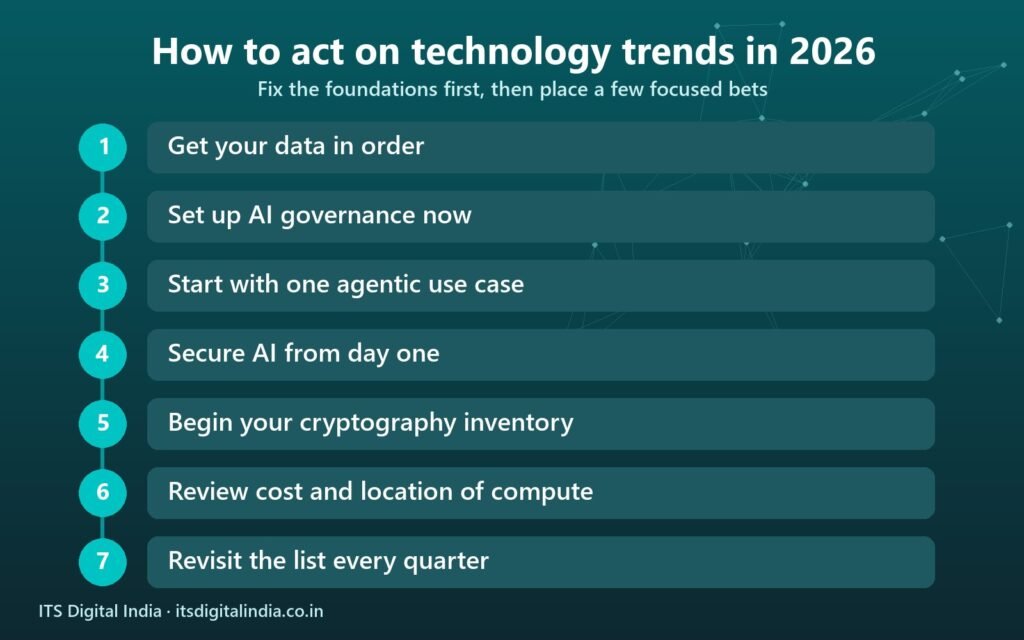
- Get your data in order. Data quality is the top barrier to AI adoption, cited by 58% of leaders in the Mayfield survey. Agents and domain-specific models are only as good as the data behind them. A single system of record, such as a cloud ERP or Bitrix24 CRM, is often the first fix.
- Set up AI governance now. Create an inventory of AI systems, assign owners and write a simple acceptable-use policy. This protects you under the EU AI Act and speeds up enterprise sales.
- Start with one agentic use case. Choose a measurable, repetitive process. Define success metrics such as hours saved, error rate or cycle time before you launch.
- Secure AI from day one. Give agents their own identities, least-privilege access and activity logs. Train staff to verify unusual payment requests through a second channel.
- Begin your cryptography inventory. Post-quantum migration is a multi-year project, so knowing where encryption lives is the first milestone.
- Review cost and location of compute. Track AI spend per use case and confirm where sensitive data is stored and processed.
- Revisit the list every quarter. These trends are moving fast. A short quarterly review keeps your roadmap aligned with regulation, vendor offerings and competitor moves.
The common thread is trust. Businesses that can show their AI is accurate, secure, compliant and authentic will win customers’ confidence, and their contracts.
Frequently asked questions about technology trends 2026
What is the biggest technology trend in 2026?
Agentic AI is the biggest technology trend of 2026. AI agents now carry out multi-step tasks on their own, and 42% of large enterprises already run them in production.
How will technology trends in 2026 affect small businesses?
Small businesses benefit most from AI-native development tools and off-the-shelf AI agents, which cut the cost of custom software and automation. They should also prepare for deepfake fraud and new AI disclosure rules if they serve EU customers.
Is the EU AI Act in force in 2026?
Yes. Transparency obligations under Article 50 have applied since 2 August 2026. Rules for high-risk AI systems were deferred to 2 December 2027 and 2 August 2028.
Do businesses need to worry about quantum computing now?
Yes, for security planning. NIST plans to deprecate RSA-2048 after 2030, and stolen encrypted data can be decrypted later. Starting a cryptography inventory in 2026 is a sensible first step.
Which emerging technologies of 2026 offer the fastest return on investment?
Among the emerging technologies 2026 has produced, AI agents for repetitive workflows and AI coding tools usually show returns fastest, often within months. Robotics, sovereign cloud and post-quantum security are longer-term investments driven by risk and regulation.
Conclusion
The technology trends of 2026 show AI growing up. It is acting on its own through agents, becoming specialised through domain models, and being held to account through regulation, security and provenance. Around it, the foundations are shifting too: encryption is being rebuilt for the quantum era, data is moving closer to home, and the power grid has become a technology issue.
The businesses that pull ahead will not be the ones that adopt every trend first. They will be the ones that pick the right two or three, build on clean data and strong governance, and earn trust at every step.
Ready to act? Pick the one trend from this list that would most change your business in the next 12 months, and schedule a 30-minute session with your team this week to scope a first pilot. If you would like help, book a free consultation with ITS Digital India: we build AI-assisted software, CRM automation and ERP systems for growing businesses.
Sources
- Gartner Identifies the Top Strategic Technology Trends for 2026 (Business Wire, October 2025)
- The Agentic Enterprise in 2026 (Mayfield CXO Survey, January 2026)
- Gartner: AI agents will command $15 trillion in B2B purchases by 2028 (Digital Commerce 360)
- EU AI Act 2026: what actually changed and what deployers still must do (Process Excellence Network)
- EU AI Act’s High-Risk Deadline: Deferred, Not Cancelled (Cloud Security Alliance)
- How to Migrate Your Platform for Post-Quantum Cryptography (Entrust, August 2026)
- Data Centers Will Use Twice as Much Energy by 2030 (Scientific American, on IEA’s Energy and AI report)
- Humanoid Robot Companies: The 2026 Guide (Layer3 Labs)
- Humanoid Robots topic: Gartner on production-scale deployment (Supply Chain 24/7)
- Deepfake Statistics 2026: Fraud and Detection Data (Digital Applied, citing Entrust 2026 Identity Fraud Report)
Leave a Reply